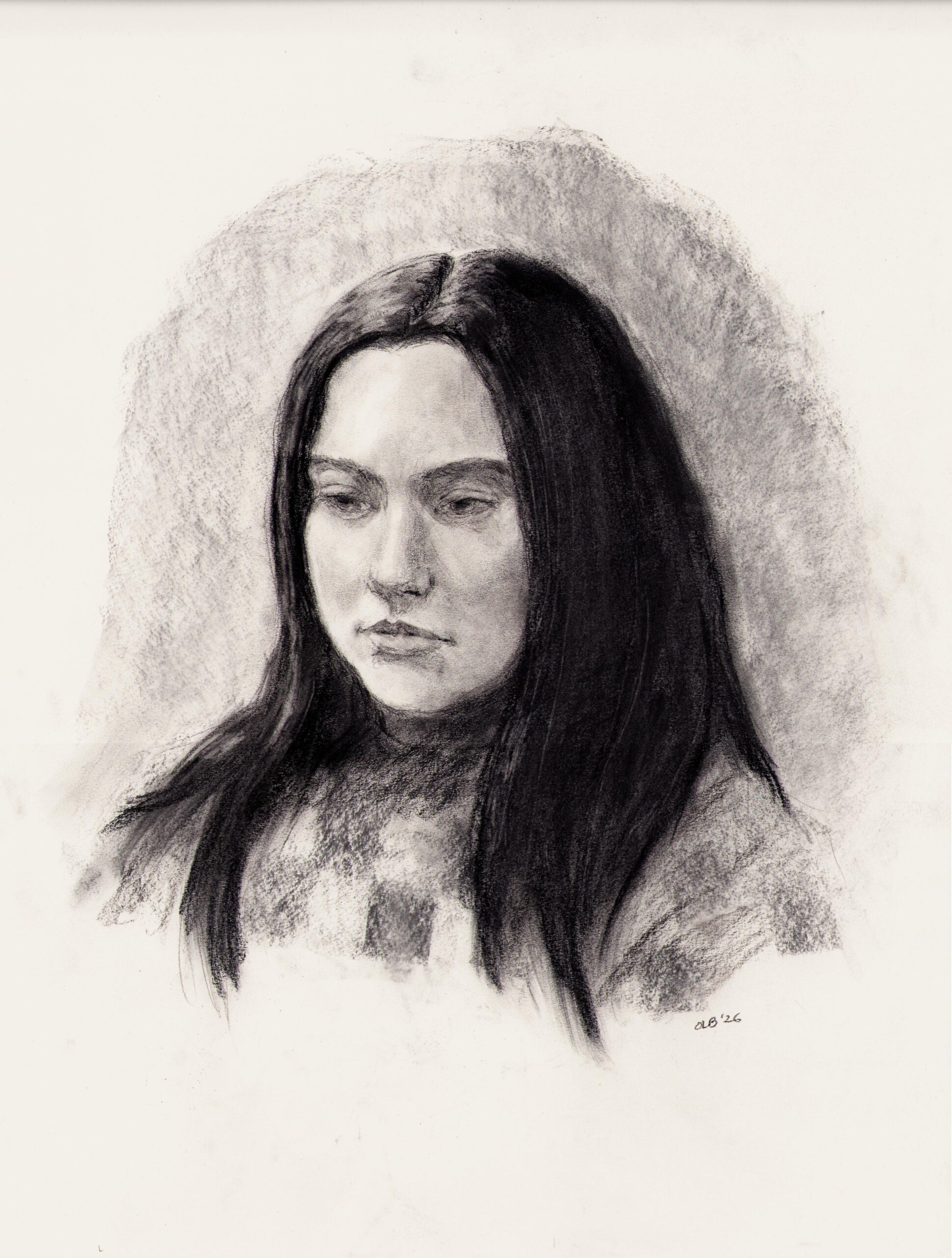
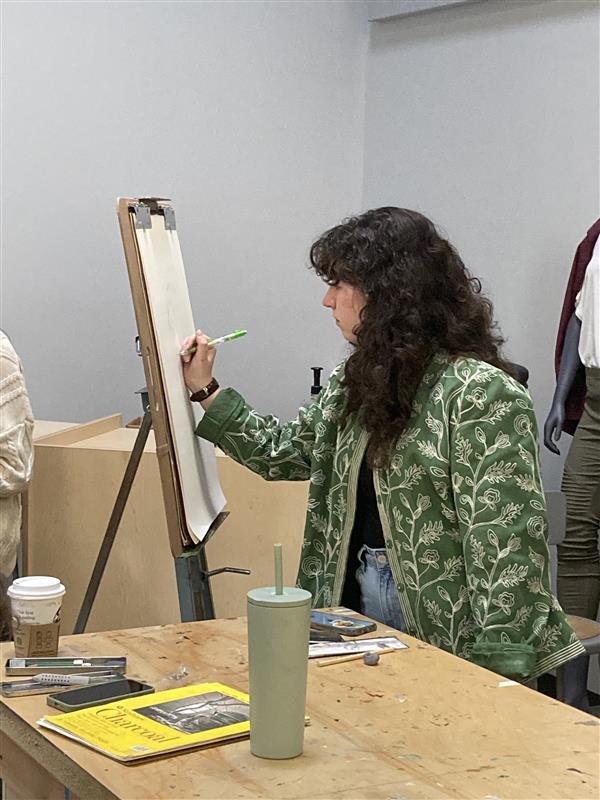
It is now time to recount my next life drawing session and the challenges and growth it produced. The first full-length session, as recounted in my last post, gave me many difficulties. This was to be expected, of course, since life drawing is a new experience for me, and this week I found myself hoping I could avoid some of the trials I faced.
For most of this week, I struggled to find a model at all. My sister was, understandably, unwilling to model again after the multiple frozen hours I put her through last week, and I would have preferred to draw a new face either way. My parents were also unwilling, and I even told my dad he could take a nap while I drew him. This was not as tempting of an offer as I thought, as it was met with a resounding no. One of my best friends was too busy, and admitted she also felt too shy to sit and be drawn, and at this point I was becoming a bit desperate and thinking of what I could use as a bribe. Thankfully, my fellow artist Elise stepped in, and I am eternally grateful to her for saving this week’s project.
This time, since myself and some others gathered in the painting lab to draw her, we had access to a more professional lighting setup. We tried to achieve “Rembrandt lighting” to best accent the planes and general forms of her face, and I could already see this would be a great improvement over my homemade attempt from the week prior. In addition, I also tried drawing her from the right side, since my other timed portraits done in class were drawn from the left.
For the first session, I wanted to feel more confident in my overall construction. I measured angles more consistently this time in order to have a more solid foundation. Looking back, I could have still measured even more extensively and better delineated where the shadows were going to fall. I noticed a classmate excellently capturing this with confident strokes for her underdrawing, and I intend to implement that method in my next attempt.
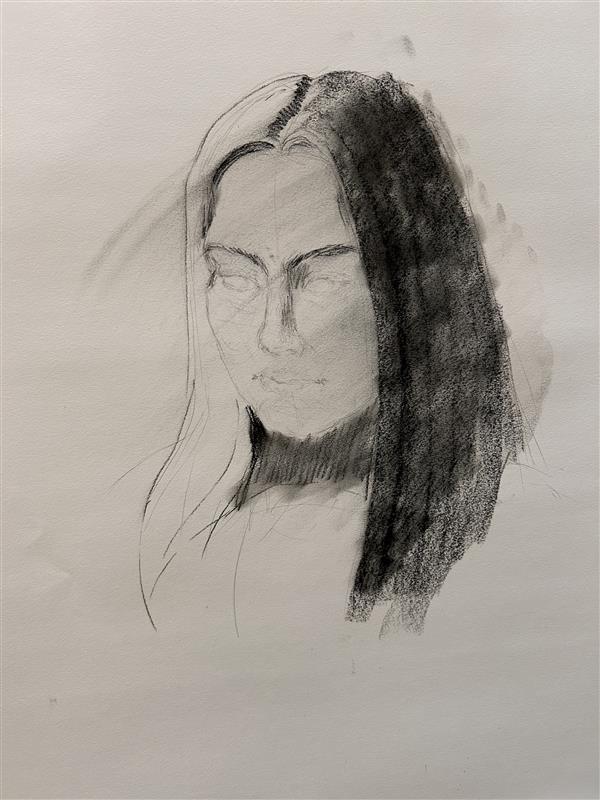
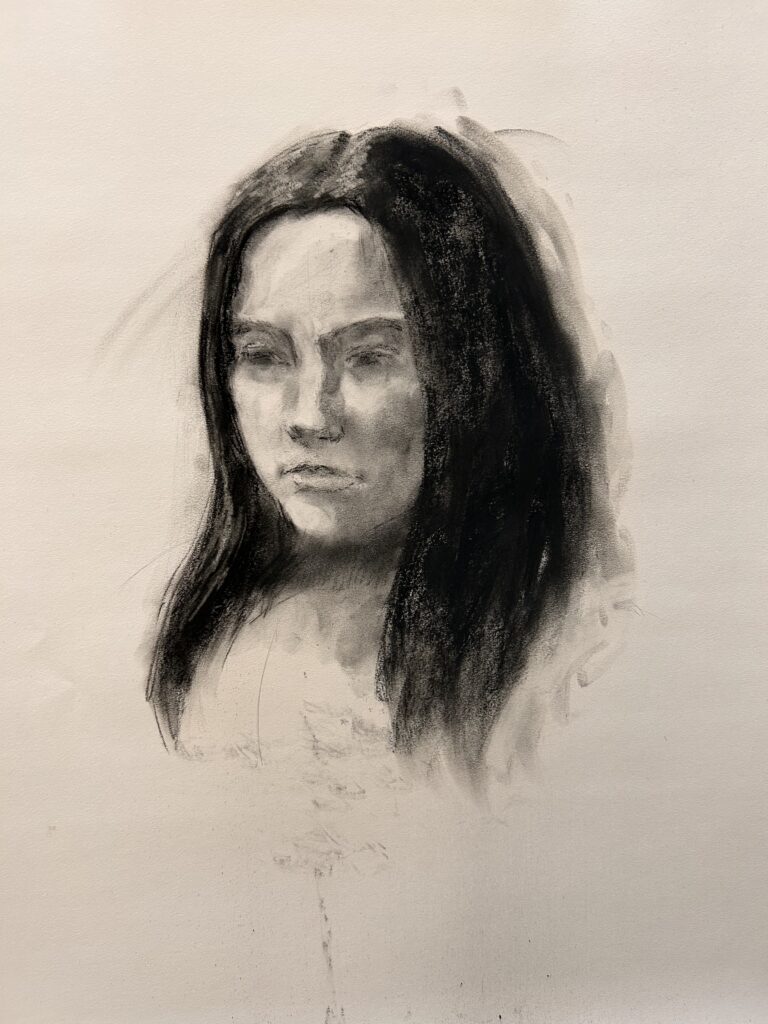
As time passed and I felt generally alright with my underdrawing, I finished adding dark strokes for the hair. This time, I did not leave in highlights, intending to erase them out later, but in the future I will simply leave white spaces the best I can. It is, after all, difficult, to return the paper to its original brightness. I then implemented a technique I learned from Nathan Fowkes, which involves smearing the charcoal powder from the darkest darks over the face in order to create an even midtone. This worked out pretty well, although it was a bit messy. I now had a base on which both the highlights and shadows would hopefully stand out.
I began laying out where the shadows would be across the plains of the face, and ended up having much trouble drawing Elise’s downcast eyes. If I recall correctly, I resketched them at this stage around 4 different times (and then later a fifth during studio hours!) During a break, she provided some helpful advice, which was to not worry about the “lines” of the eyes so much, rather, “sculpting” out the forms from a general shadow shape would help me obtain a better result. This ended up helping greatly as I tried to finish up the portrait.
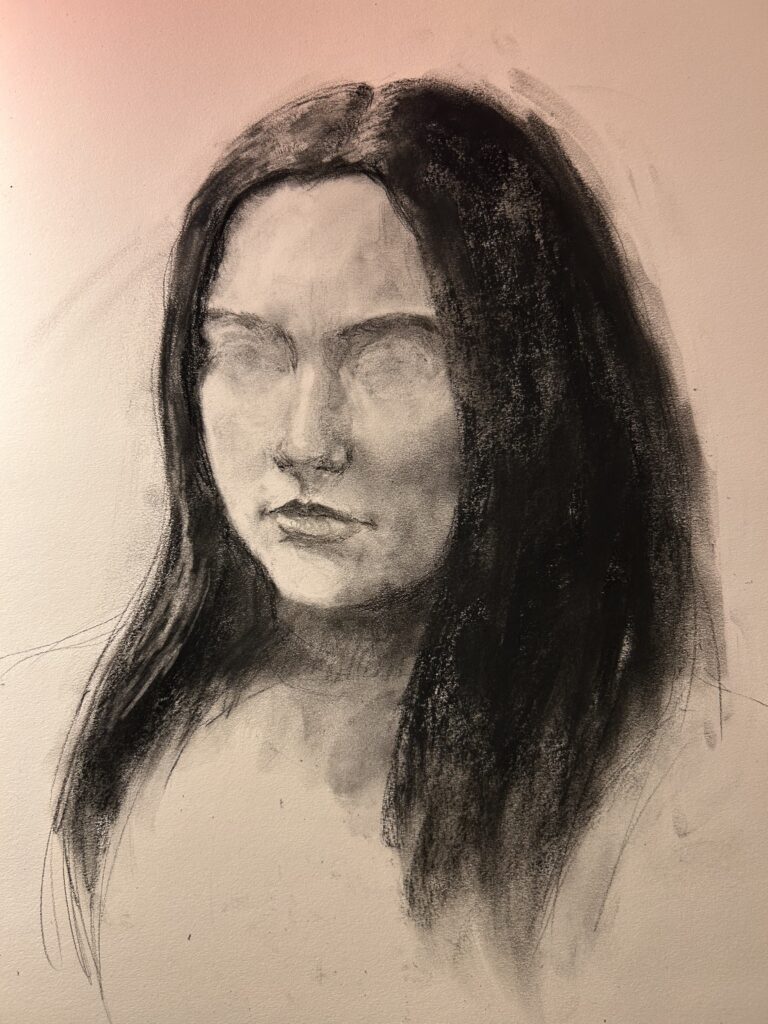
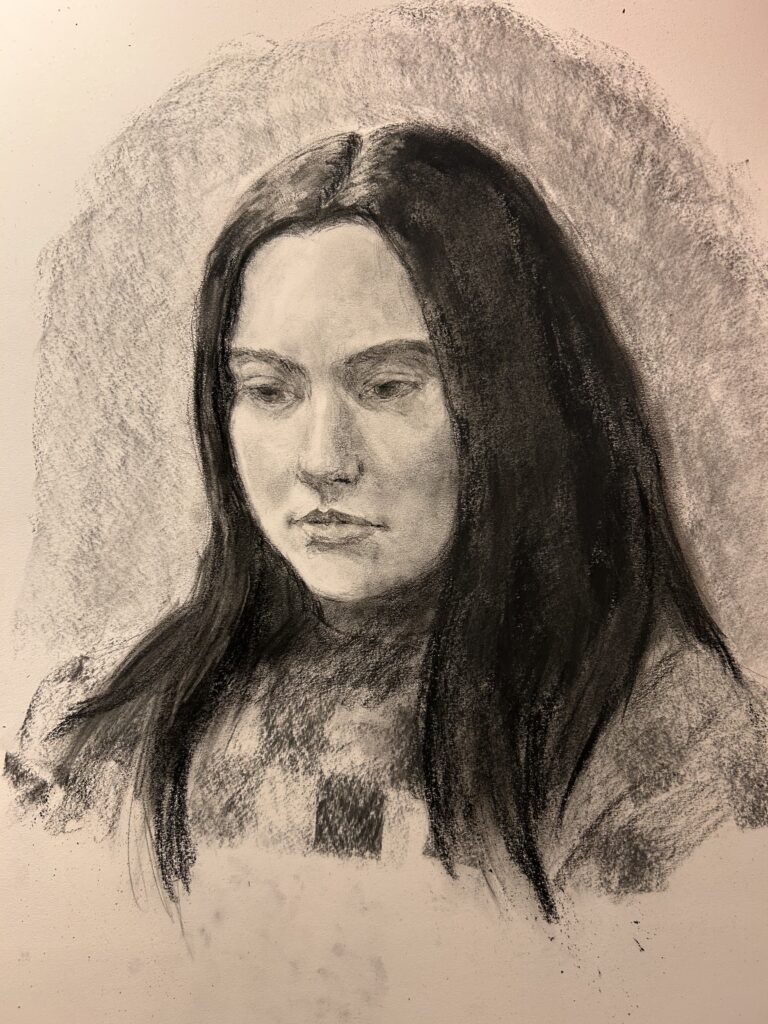
Because Elise could only model for a certain time slot, and I was scheduled to work towards the end, I knew I would end up missing some of the life drawing time. I sped up my workflow as much as possible while still trying to stay accurate, and continued carving out the correct shapes while I was actually in front of the model. I then took a picture and headed out to assist in a classroom.
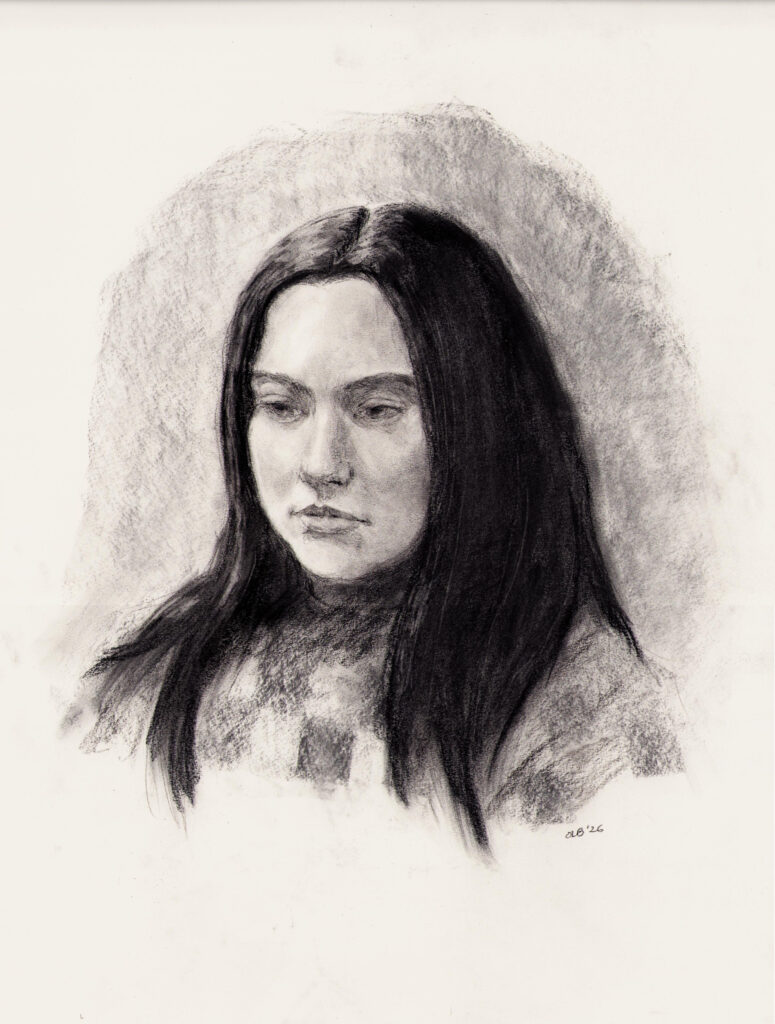
Over the weekend, using the photo I took, I redrew her eyes according to the method she showed me. In addition, I attempted to create more accurate edges for this portrait, softening the shadows around her chin and side of her face. I also darkened her hair, added highlights, and was continually aware of the subtleties in the change of forms in a face. It is very true that our eyes can pick up on many more values than our charcoal can depict, so I also tried to keep my lighting simple but readable.
Overall, I am happier with how this portrait turned out. I caught and changed some previous mistakes I made, but I can still see where my edges should be cleaner in order to properly communicate the lighting and shadows. An unexpected fun aspect was using the side of some vine charcoal to add the pattern from the checkered sweatshirt she wore. This portrait took around four hours, and I used vine charcoal, pencils, compressed charcoal, and my kneaded eraser. In the future, I hope to improve even more on the values, edges, and likenesses in my portraits.
Leave a Reply